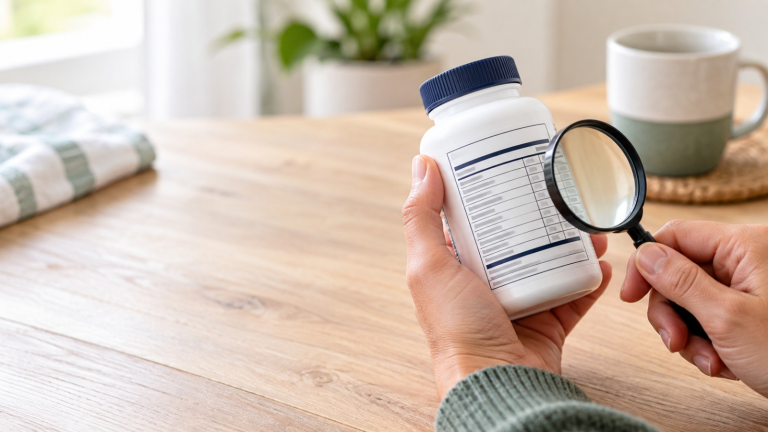

Quality claims can make a dietary supplement look reassuring. A label may say “lab tested,” “third-party tested,” or “certified,” and the package may display a seal. Those details can be useful, but they do not all mean the same thing. The value of a testing claim depends on who performed the evaluation, what was tested, which product or batch was covered, and whether the result can be independently verified.
Third-party testing is mainly a quality-control signal. Depending on the program, it may help confirm that a product contains the listed ingredients, meets limits for certain contaminants, or was produced under specified manufacturing standards. It does not automatically prove that the supplement will produce a health benefit, that it is appropriate for every person, or that every marketing claim is supported by strong clinical evidence.
What third party testing may verify
Independent programs do not all use the same standards. A meaningful certification may evaluate one or more of the following areas:
- Identity: whether the tested ingredients are what the label says they are.
- Strength or amount: whether tested ingredients are present in amounts that are reasonably consistent with the Supplement Facts panel.
- Purity: whether the product meets defined limits for specified contaminants, such as certain heavy metals, microorganisms, or other unwanted substances.
- Performance: whether a tablet or capsule meets applicable requirements, such as disintegration or dissolution, when included in the program.
- Manufacturing controls: whether the manufacturing facility and quality systems meet the requirements of the certification program.
- Ongoing compliance: whether the program includes audits, market sampling, or periodic retesting rather than a one-time laboratory result.
The exact scope matters. A test for microbial contamination does not necessarily verify ingredient amounts. A raw-material test does not automatically certify the finished product. A single batch report also does not establish that every future batch will be identical.
What a seal or laboratory claim does not prove
A quality seal should not be treated as a medical endorsement. According to the National Institutes of Health Office of Dietary Supplements, independent quality seals can indicate that a product was properly manufactured, contains the ingredients listed on the label, and does not contain harmful levels of contaminants covered by the program. These seals do not guarantee that a supplement is safe or effective.
- It does not mean the supplement is FDA approved. The FDA does not approve dietary supplements for safety and effectiveness before they are sold to the public.
- It does not prove that the product prevents, treats, or cures a disease.
- It does not confirm that the supplement is suitable for every age, health condition, pregnancy status, or medication regimen.
- It does not eliminate the possibility of side effects, allergies, or interactions with medicines and other supplements.
- It does not validate every statement made on a sales page, testimonial, advertisement, or social media post.
- It does not necessarily cover every ingredient, contaminant, or batch unless the certification program says that it does.
Third party tested and third party certified are not identical
The phrase “third-party tested” is broad. It may mean that an outside laboratory analyzed a sample chosen by the manufacturer. The claim is more useful when the company identifies the laboratory, explains what was tested, provides a current certificate of analysis, and connects the report to a specific lot number.
Third-party certification usually refers to a defined program with published requirements. Depending on the certifier, it can include product testing, label review, facility audits, documentation review, periodic surveillance, or retesting. Even then, consumers should check the certifier’s public directory and understand the certification’s scope.
Examples of established quality programs
USP and NSF are two established organizations with dietary supplement quality programs. Their marks should be evaluated according to the rules and directories published by each organization. Mentioning these programs is not an endorsement of a particular product, and the absence of one of these marks does not by itself prove that a product is poor quality.
- USP Verified: USP describes its program as evaluating dietary supplements against science-based quality standards and current Good Manufacturing Practices. The program includes product testing, manufacturing-facility review, and continued monitoring.
- NSF Certified: NSF describes its dietary supplement certification as testing products against defined standards and reviewing manufacturing practices. Its program may include facility audits and periodic retesting.
Other laboratories and certification programs also exist. The important question is not whether a package displays an impressive symbol, but whether the organization is independent, the standard is clear, the certification is current, and the exact product can be verified.
How to evaluate a testing claim
- Identify the organization. Look for the full name of the laboratory or certifier rather than a vague statement such as “quality tested.”
- Verify the exact product. Search the certifier’s official directory and confirm the product name, form, flavor, serving size, and manufacturer when those details are provided.
- Check the scope. Determine whether the program assessed identity, ingredient amounts, contaminants, manufacturing practices, banned substances, or only one of these areas.
- Look for current information. Confirm that the certification or report is still valid and, when applicable, connected to the lot number on the package.
- Review the certificate of analysis carefully. A useful certificate should identify the tested sample, date, methods or specifications, results, and laboratory. A generic document with no lot number offers less assurance.
- Separate quality from effectiveness. Product quality is important, but it does not answer whether the ingredient is likely to help with your goal or whether the dose is appropriate for you.
- Ask a healthcare professional. This is especially important if you take prescription medicines, have a medical condition, are pregnant or breastfeeding, or are considering a supplement for a child.
Red flags to watch for
- A label or sales page uses an FDA logo or says “FDA approved” for an ordinary dietary supplement.
- The company says “clinically proven” without identifying the study, the tested ingredient, the dose, and whether the finished product was studied.
- A testing badge has no link to a certifier, public directory, report, or explanation of what was evaluated.
- The certificate is old, belongs to a different product, or does not match the lot number.
- The product promises a guaranteed result or claims to replace medical treatment.
- The seller uses a facility registration or compliance statement as if it were proof that the finished supplement was approved or medically effective.
A practical checklist before buying
- Can I verify the testing organization independently?
- Does the report or certification apply to this exact finished product?
- What quality attributes and contaminants were actually tested?
- Is the certification current, and does the program include ongoing monitoring?
- Are the ingredients and amounts clearly listed on the Supplement Facts panel?
- Are warnings, allergens, serving directions, and manufacturer contact details easy to find?
- Does the marketing distinguish evidence about an ingredient from evidence about the finished product?
- Have I checked for possible interactions with medicines or health conditions?
The bottom line
Third-party testing can add useful information to a supplement decision, especially when the testing is independent, transparent, current, and tied to the exact product. The strongest claims explain who tested the product, what standards were used, what the results cover, and how consumers can verify them.
A seal is one part of the evaluation, not a substitute for reading the label, reviewing credible evidence, considering personal health factors, and speaking with a qualified healthcare professional when appropriate.
Continue reading
- What Supplement Labels Can and Cannot Tell You
- How to Evaluate a Dietary Supplement Before Buying
- Dietary Supplements and Prescription Medications
Medical disclaimer
This article is for educational purposes only and is not medical advice. Dietary supplements may cause side effects or interact with medicines and health conditions. Consult a qualified healthcare professional before starting, stopping, or changing a supplement, especially if you are pregnant or breastfeeding, take medication, have a medical condition, or are considering a product for a child.
Editorial and affiliate disclosure
Trusted Health Select provides educational wellness content and independent product reviews. Some pages may contain affiliate links, which means we may earn a commission if you make a purchase through those links, at no additional cost to you. Affiliate relationships do not change the criteria used in our review process.
Sources for the article
- U.S. Food and Drug Administration — FDA 101 Dietary Supplements
- NIH Office of Dietary Supplements — Dietary Supplements What You Need to Know
- NIH Office of Dietary Supplements — Frequently Asked Questions
- USP — Dietary Supplement Verification Program
- NSF — Dietary Supplement and Vitamin Certification