
How to Evaluate a Dietary Supplement Before Buying
A polished label and a long list of ingredients do not tell you whether a dietary supplement is appropriate for you. A useful evaluation begins with a simpler question: what exactly is the product supposed to do, and does the label give you enough information to judge it?
Dietary supplements can include vitamins, minerals, herbs, amino acids, enzymes, and other dietary ingredients. They are not regulated in the same way as prescription or over-the-counter drugs. In most cases, the U.S. Food and Drug Administration does not review a supplement for safety and effectiveness before it reaches the market. That makes careful reading especially important.
Start With the Supplement Facts Label
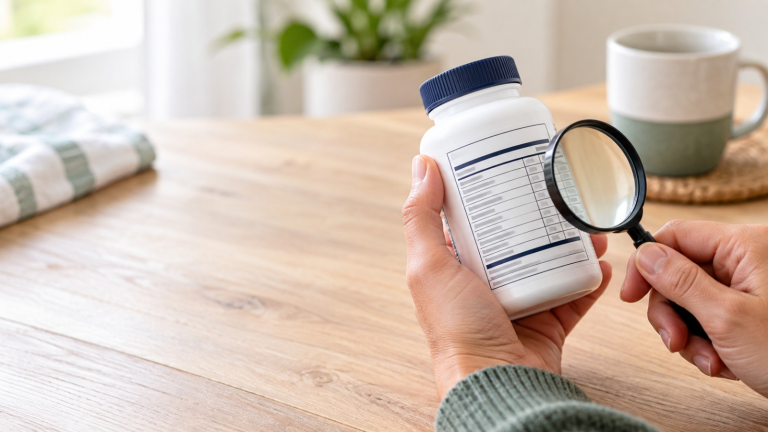
Look for the serving size, number of servings, ingredient names, amount per serving, and percent Daily Value when one has been established. Check whether the suggested serving is one capsule, several capsules, a scoop, or multiple droppers. A bottle that appears to contain a three-month supply may last much less time when the actual serving is considered.
Compare the amounts with your other supplements. Multivitamins, eye formulas, joint products, and specialty blends may repeat the same vitamins or minerals. Taking several products can unintentionally raise the total amount you consume.
Look Beyond the Ingredient List
An ingredient can be familiar without being present at a meaningful dose. When a product lists exact amounts, you can compare them with the amounts used in credible research and with established intake guidance. When it uses a proprietary blend, the label may show only the total weight of the blend, not the amount of each component.
A proprietary blend is not automatically poor quality, but it limits what a buyer can verify. A large number of ingredients packed into a small total blend can also mean that each one is present in a modest amount.
Separate Ingredient Evidence From Product Evidence
Marketing pages often cite research involving one ingredient and then imply that the finished multi-ingredient product will produce the same result. That conclusion may not be justified. Research findings can depend on the exact ingredient form, species or strain, dose, study population, duration, and outcome measured.
Ask whether the finished product itself was studied. If the answer is no, treat ingredient research as background information, not proof that the complete formula has been clinically demonstrated to work.
Understand the Type of Claim
A supplement may use a structure or function statement such as “supports healthy bones” or “supports normal circulation.” That is different from claiming to diagnose, treat, cure, mitigate, or prevent a disease. Disease-treatment claims belong to drugs, not ordinary dietary supplements.
Be cautious when a sales page promises to reverse a condition, replace medication, repair an organ, eliminate symptoms permanently, or deliver dramatic results within a precise number of days. A disclaimer at the bottom does not make an unsupported headline reliable.
Check Safety Before You Check Out
Natural does not automatically mean safe. Botanicals and concentrated extracts can cause side effects, interact with medications, affect bleeding, change how the body processes a drug, or create problems around surgery. Risk can also depend on age, pregnancy, nursing, allergies, kidney or liver function, and other medical conditions.
Write down every prescription drug, over-the-counter medicine, vitamin, mineral, herb, powder, and drink mix you use. A pharmacist or qualified healthcare professional can review the complete list more effectively than a product page can.
Review Quality Signals Without Overinterpreting Them
A statement such as “made in a GMP facility” relates to manufacturing practices; it does not prove that the product is effective. “Third-party tested” is more useful when the company identifies the testing organization and explains whether identity, strength, purity, contaminants, or finished batches were evaluated.
Words such as premium, advanced, doctor-formulated, certified, verified, or clinically inspired need context. Look for specific documentation rather than relying on a badge or slogan.
Read the Commercial Terms
Before paying, confirm the number of bottles, total charge, shipping cost, taxes, delivery area, subscription status, cancellation rules, and refund conditions. Determine whether the order is a one-time purchase or an automatic shipment. Save a copy of the offer and order confirmation.
A money-back guarantee can reduce financial risk, but only if you understand the deadline, return address, required authorization, product-return rules, and whether shipping is refundable.
A Practical Prepurchase Checklist
- The purpose of the product is stated in realistic terms.
- The current label shows the serving size and complete ingredient list.
- Ingredient amounts are disclosed, or the limits of a proprietary blend are understood.
- Research on ingredients is not being presented as proof of the finished product.
- You have checked for duplicated nutrients and medication interactions.
- The seller clearly explains price, shipping, recurring charges, and refund terms.
- The page does not pressure you with unverifiable countdowns, stock claims, or guaranteed outcomes.
- You know who manufactures or sells the product and how to contact support.
The Bottom Line
A good supplement decision is not based on the longest formula or the strongest promise. It is based on a clear label, reasonable claims, relevant evidence, transparent commercial terms, and a safety review that reflects your own health history. If essential information is missing, waiting is a valid decision.
Explore our independent product reviews to see how Trusted Health Select applies these questions to individual supplements.
Link interno: colocar “independent product reviews” apontando para a página geral Reviews. Não inserir link de afiliado neste artigo.
Medical disclaimer: This article is for general educational purposes and is not medical advice. Ask a qualified healthcare professional about medications, symptoms, medical conditions, pregnancy, nursing, surgery, or supplement safety.